If you’re using ClickUp to boost your productivity, you might be wondering what’s new with the latest update. Should you stick with ClickUp 2.0, or is ClickUp 3.0 worth the switch?
Both versions promise powerful tools to help you manage tasks, projects, and teams — but the differences could change how you work every day. You’ll discover the key upgrades in ClickUp 3.0 and how they compare to the 2.0 version. Whether you want smoother workflows, better customization, or smarter automation, understanding these changes will help you decide which version fits your style best. Ready to maximize your productivity and replace all your apps with one platform? Check out ClickUp here: ClickUp. Keep reading to find out which version will take your efficiency to the next level!
Introduction To Clickup 2.0 And 3.0
ClickUp remains a popular productivity tool that helps teams and individuals organize work. The release of ClickUp 3.0 builds on the strong foundation of ClickUp 2.0. Both versions offer unique features that aim to improve task management and collaboration. Understanding their differences helps users pick the best fit for their needs.
Overview Of Clickup As A Productivity Tool
ClickUp is designed to replace multiple apps by combining tasks, docs, chat, and goals in one place. It suits teams of all sizes who want to boost productivity and reduce app switching. Key features include:
- Task management with customizable views
- Built-in time tracking and automation
- Collaboration tools like comments and real-time chat
- Integrations with popular apps and AI tools
ClickUp’s flexibility makes it suitable for many industries, from marketing to software development.
Purpose And Evolution From 2.0 To 3.0
ClickUp 2.0 laid the groundwork with a strong focus on task organization and team collaboration. It helped users centralize work and customize workflows. The move to 3.0 targets faster performance and improved user experience. Key upgrades include:
| Feature | ClickUp 2.0 | ClickUp 3.0 |
|---|---|---|
| User Interface | Functional but complex | Simpler and more intuitive |
| Speed | Moderate load times | Faster and smoother |
| Automation | Basic automations | Expanded automation options |
| AI Assistance | Limited AI features | Integrated AI tools for tasks |
These improvements aim to help users manage complex projects with ease and less friction.
Why Comparing Versions Matters For 2026 Users
Users in 2026 face more demanding workflows and expect quicker results. Choosing the right ClickUp version can affect productivity. Here’s why the comparison is important:
- Performance: Faster tools save time daily.
- Features: Newer versions offer enhanced capabilities.
- Compatibility: Updated software fits better with modern apps and devices.
- Cost-effectiveness: Picking the right plan avoids paying for unused features.
Users should weigh their team size, project complexity, and budget before deciding.

Credit: stackset.com
Key Features Of Clickup 2.0
ClickUp 2.0 offers a solid foundation for managing tasks and teams efficiently. It focuses on simplicity and flexibility, giving users control without overwhelming complexity. This version appeals to users seeking familiar tools with room for customization.
User Interface And Navigation: Familiar Layout For Smooth Workflow
The interface in ClickUp 2.0 is designed to feel familiar to users of common productivity apps. It uses a clear sidebar menu for quick access to Spaces, Projects, and Lists. Navigation is straightforward, helping users focus on their work.
- Simple sidebar with nested folders and lists
- Drag-and-drop task organization
- Minimalist design to reduce distractions
This layout supports a smooth workflow by minimizing the learning curve for new users.
Task Management Capabilities: Customization And Workflow Options
Task management in ClickUp 2.0 is highly customizable. Users can create tasks with multiple statuses, priorities, and tags. The platform supports:
- Custom fields to track specific data
- Multiple views such as List, Board, and Calendar
- Task dependencies and reminders
Workflows can be tailored to fit different project needs, making task tracking more flexible and organized.
Collaboration Tools: Effective Team Communication And Sharing
ClickUp 2.0 includes features to boost team collaboration. It offers:
- Task comments with @mentions for direct communication
- Document sharing and real-time editing
- Notification system to stay updated on changes
These tools ensure clear communication and keep everyone aligned on project progress.
Automation And Integrations: Streamlining Repetitive Processes
Automation in ClickUp 2.0 helps reduce manual work by automating routine tasks. It supports:
- Simple triggers like task status changes
- Actions such as assigning tasks or sending alerts
- Integrations with popular apps like Google Drive and Slack
These features streamline workflows and connect ClickUp with existing tools for better efficiency.
Key Features Of Clickup 3.0
ClickUp 3.0 introduces powerful updates that improve productivity and user experience. This version focuses on a cleaner interface, smarter tools, and better collaboration options. Every feature is designed to help teams work faster and smarter.
Redesigned User Interface: Enhanced Usability And Modern Look
The interface of ClickUp 3.0 is fresh and modern. It has a simplified layout that helps users find what they need quickly. The design uses clear icons and better spacing for easy navigation. This update reduces clutter and improves focus on tasks.
- Clean, minimalistic design
- Improved font readability and color contrast
- Customizable themes for personal preferences
- Consistent design across all devices
Advanced Home And Inbox Management Centers: Centralized Control
ClickUp 3.0 offers upgraded Home and Inbox centers. These act as command hubs for tasks, notifications, and updates. Users can manage all their work from one place without switching screens.
- Unified task view from all projects
- Priority sorting and filtering options
- Real-time notification updates
- Quick task actions directly from inbox
Improved Navigation And Quick Actions (tools): Faster Access
Navigation is faster with new quick action tools. Users access important features with fewer clicks. The command bar supports shortcuts for common tasks. This speeds up workflow and reduces interruptions.
- Quick command bar for task creation and search
- Keyboard shortcuts for navigation
- Contextual menus for task options
- Faster switching between projects and views
Conditional Logic In Forms: Smarter Data Collection
Forms now support conditional logic. This means questions change based on previous answers. It makes forms shorter and more relevant. Data collection becomes precise and efficient.
- Display questions based on user input
- Skip irrelevant fields automatically
- Build dynamic workflows with form responses
- Reduce form abandonment with simpler steps
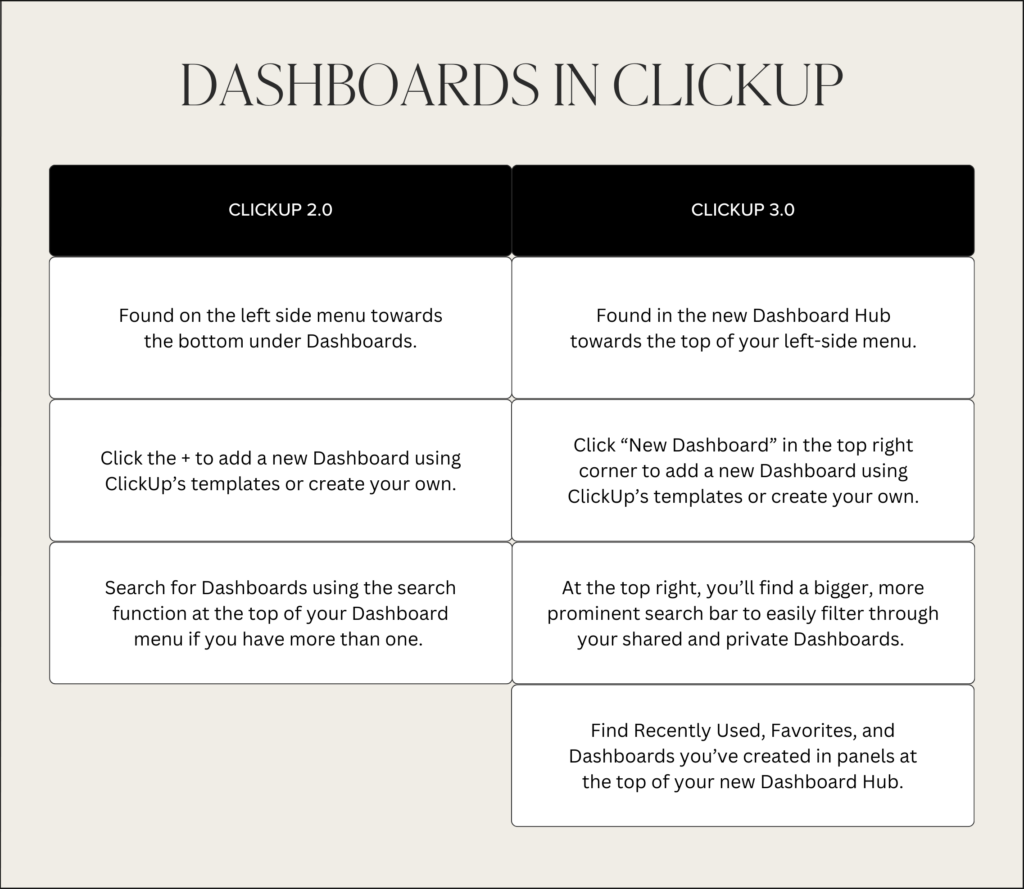
Whiteboards And Visual Collaboration: Boosting Creativity
Whiteboards in ClickUp 3.0 allow teams to brainstorm visually. They support drawing, sticky notes, and shapes. This feature helps plan projects and solve problems creatively.
- Drag and drop elements easily
- Real-time collaboration with team members
- Integration with tasks and documents
- Multiple templates for different use cases
Credit: taylormonroe.co
Pricing And Affordability Comparison
ClickUp offers different pricing tiers for diverse user needs. Comparing versions 2.0 and 3.0 reveals changes in plans and costs. Understanding these helps pick the best option for personal or team use. This section breaks down pricing and value in detail.
Free Forever Plan: Suitability For Personal Use
The Free Forever Plan is ideal for individuals. It provides a solid base of features without any cost. Users can:
- Manage tasks and projects with basic tools
- Access limited storage and integrations
- Use it indefinitely without upgrade pressure
This plan suits students, freelancers, and simple task management needs.
Unlimited Plan: Benefits For Small Teams And Storage
The Unlimited Plan targets small teams requiring more space and features. Key benefits include:
- Unlimited storage for files and documents
- Advanced automation and integrations
- Collaborative features for team projects
- Priority support
This plan enhances productivity and team coordination at a moderate price.
Cost Differences Between 2.0 And 3.0 Versions
| Plan | ClickUp 2.0 Price | ClickUp 3.0 Price | Notes |
|---|---|---|---|
| Free Forever | $0 | $0 | Same features, unlimited use |
| Unlimited | $5/user/month | $7/user/month | Price increased with added features |
The 3.0 version shows a slight price increase for the Unlimited Plan. The Free Plan remains unchanged.
Value For Money: Features Versus Pricing
ClickUp 3.0 offers new features that add value despite higher costs. These include:
- Enhanced automation capabilities
- Better AI assistance
- More integrations with external apps
- Improved user interface and performance
Users paying a bit more get improved functionality. The Free Plan stays generous for personal use. Small teams benefit from expanded storage and support in the Unlimited Plan.
Overall, pricing aligns with the features offered, making ClickUp affordable for many users.
Pros And Cons Based On Real-world Usage
Users of ClickUp often compare versions 2.0 and 3.0 based on daily experience. Each version has unique strengths and weaknesses. Understanding these helps teams decide which fits their needs best. Real-world usage reveals how stability, features, and ease of use vary between these versions.
Strengths Of Clickup 2.0: Stability And Familiarity
ClickUp 2.0 offers a stable platform that many users find reliable. Its interface is familiar, making it easier for teams to adopt quickly.
- Consistent performance with fewer bugs.
- Well-known layout supports quick navigation.
- Strong integration with existing workflows.
- Good for users who prefer a predictable experience.
Many users appreciate the simplicity and trust the 2.0 version for steady project management.
Limitations Of Clickup 2.0: Setup Complexity And Interface Constraints
Despite its strengths, ClickUp 2.0 has complex setup steps that can slow new users.
- Initial configuration may overwhelm beginners.
- Interface lacks flexibility for advanced customization.
- Some features feel outdated compared to newer tools.
The interface limits some productivity enhancements. Users seeking modern design may find it restrictive.
Advantages Of Clickup 3.0: Innovation And Enhanced Functionality
ClickUp 3.0 introduces many innovative tools and improved features to boost productivity.
| Feature | Benefit |
|---|---|
| Improved task automation | Saves time by reducing manual work |
| Customizable dashboards | Better visibility of project status |
| Enhanced collaboration tools | Improves team communication and workflow |
| Modern interface | Easier to use and visually appealing |
Users report that these new features help manage complex projects more efficiently.
Challenges With Clickup 3.0: Learning Curve And Transition Issues
The major challenge with ClickUp 3.0 is the steep learning curve.
- Users must spend time mastering new features.
- Transition from 2.0 can disrupt workflows temporarily.
- Some legacy integrations may not work smoothly.
- Initial setup takes longer due to added options.
Patience is needed to adjust fully to the new system, especially for teams used to 2.0.
Ideal Users And Use Case Recommendations
Choosing between ClickUp 2.0 and 3.0 depends on your team’s needs and workflow style. Each version offers distinct strengths that fit different user groups. Understanding which version matches your priorities can improve productivity and reduce friction.
Who Should Stick With Clickup 2.0: Teams Prioritizing Stability
ClickUp 2.0 remains a solid choice for teams valuing a stable, familiar platform. It suits groups that:
- Prefer a proven, less complex interface
- Require minimal disruption during workflow
- Need consistent performance without frequent updates
- Focus on task management with straightforward features
This version works well for small to medium teams that want reliable project tracking without a steep learning curve.
Best Candidates For Clickup 3.0: Early Adopters And Power Users
ClickUp 3.0 targets users eager to leverage the latest features and integrations. Ideal users are:
- Comfortable adapting to new interfaces
- Looking for advanced customization and automation
- Tech-savvy teams handling complex projects
- Power users who prioritize flexibility and scalability
Early adopters gain access to enhanced AI tools and deeper workflow automation, which can boost productivity in dynamic environments.
Use Cases Where 3.0 Excels: Agile Marketing, Creative Ops, And Enterprise
ClickUp 3.0 shines in fast-paced and multifaceted workflows, such as:
| Use Case | Why ClickUp 3.0 Fits |
|---|---|
| Agile Marketing Teams | Supports iterative planning and quick task shifts |
| Creative Operations | Offers flexible asset management and collaboration tools |
| Enterprise-Level Projects | Handles complex workflows with advanced automation and reporting |
When To Consider Alternative Tools: Comparing With Wrike, Monday.com, And Others
Some teams may find other platforms better suited based on their specific needs:
- Wrike: Best for agile design and marketing teams needing strong collaboration features.
- monday.com: Ideal for teams prioritizing easy onboarding and simple project visualization.
- Screendragon: Focuses on enterprise marketing and creative operations with robust approval workflows.
- Zoho Projects: Offers drag-and-drop automation for users seeking simple task automation.
Evaluate your team’s priorities to select the right tool. ClickUp excels in customization but requires setup and management effort compared to simpler apps.

Credit: www.youtube.com
Frequently Asked Questions
What’s Better Than Clickup?
Wrike suits agile teams, Screendragon excels in enterprise marketing, monday. com offers easy onboarding, and Zoho Projects provides drag-and-drop automation. These tools can be better than ClickUp depending on your specific needs.
Is Clickup A Unicorn?
Yes, ClickUp is a unicorn. It achieved a valuation over $1 billion after successful funding rounds.
Is Clickup Better Than Todoist?
ClickUp offers extensive customization and team workflows but needs more setup. Todoist is simpler and faster, ideal for personal task tracking. Choose ClickUp for complex projects; pick Todoist for straightforward, individual use.
What Is The Difference Between Free Forever And Unlimited Clickup?
The Free Forever plan suits personal use with limited storage and features. Unlimited ClickUp targets small teams, offering unlimited storage and advanced tools.
Conclusion
ClickUp 3.0 offers smoother navigation and fresh features. Users enjoy better speed and clearer layout. Both versions help manage tasks and projects well. Choosing depends on your team size and needs. Explore ClickUp to boost your productivity daily. Start here: ClickUp.